
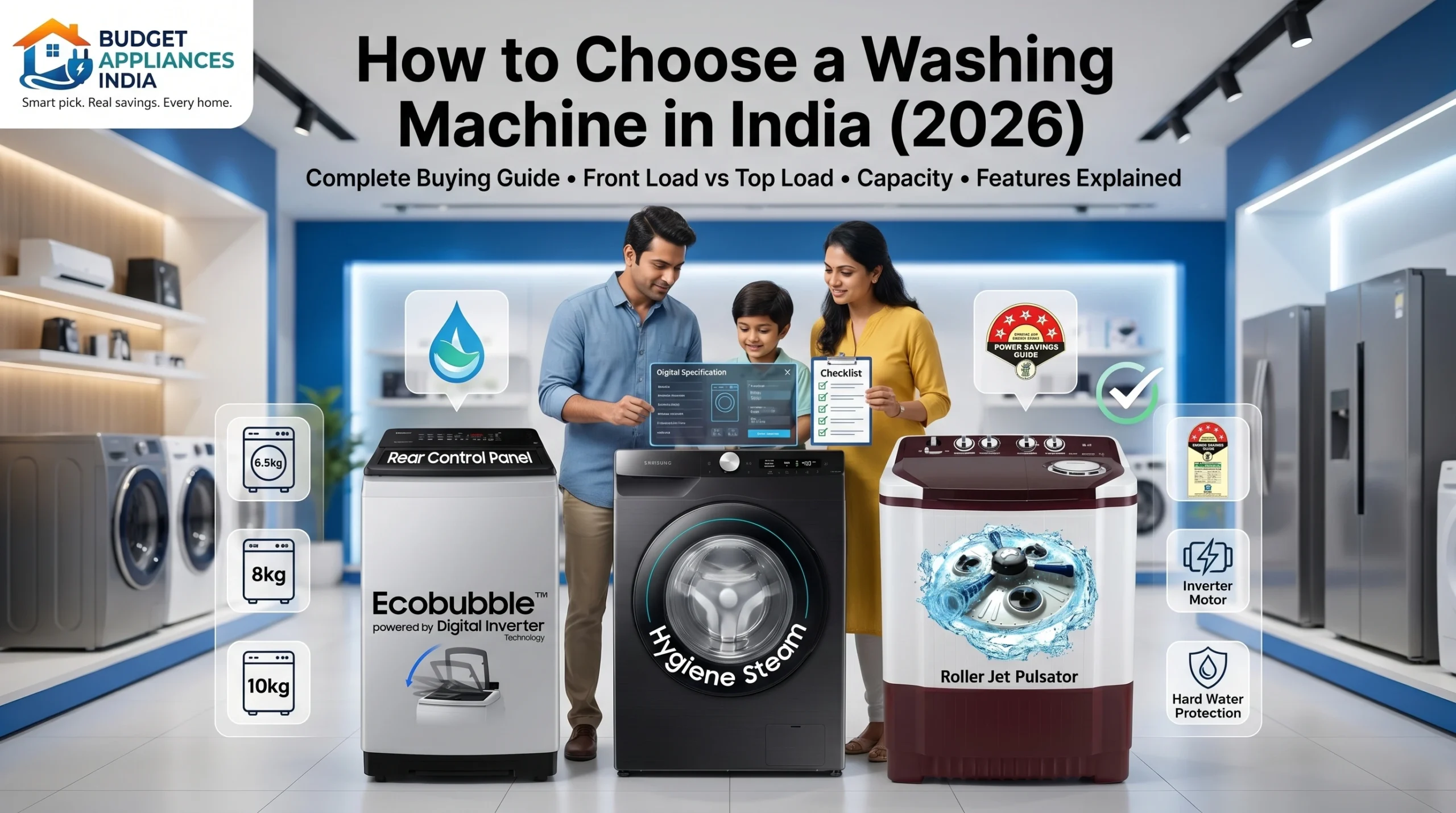
How to Choose a Washing Machine: Complete Buying Guide for India (2026)
Choosing the right washing machine for your home can feel like a massive chore. With technology moving faster than ever, stepping into an electronics showroom or browsing online marketplaces presents you with a dizzying wall of buzzwords. You will hear terms like EcoBubble, AI Direct Drive, Smart Inverter, 6th Sense, and TurboWash thrown around by salespeople and product banners. Every brand claims to possess the magic formula for pristine clothes, but how do these features translate to the realities of an Indian household?
The truth is, a washing machine is a long-term investment that should serve your family for at least 8 to 10 years. Making a blind purchase based on a discount tag or a flashy marketing brochure can lead to years of high water bills, ruined clothes, excessive noise, or worst of all, frequent breakdowns coupled with terrible post-sale service support.
🔬 How We Researched This Guide
- Specification Deep-Dive: We collected and compared technical datasheets for over 40 washing machine models available in India in 2026, covering motor types, RPM ratings, water consumption, BEE star ratings, and drum materials.
- Owner Review Analysis: We analysed more than 3,500 verified purchase reviews on Amazon India and Flipkart, specifically filtering for long-term ownership reports (12+ months) to assess real-world durability, service experience, and performance in hard-water areas.
- Technician Consultations: We spoke with authorised service technicians to understand the most common failure points by brand and model category, and which machines perform best under Indian water quality conditions.
- Independence: No brand has paid for placement in this guide. Our affiliate links are standard Amazon Associates links, and the commission rate is identical regardless of which product you choose.
📋 What’s Inside This Guide
- Core Configurations: Front Load vs. Top Load vs. Semi-Automatic
- Capacity Engineering: Matching Fabric Weight to Household Size
- Core Mechanics: Motor Technologies, Drive Systems & RPM
- Electricity Consumption & Running Costs
- Environmental Challenges: Hard Water & Low Pressure
- Brand Ecosystems: Warranties & Service Networks
- Common Problems & Maintenance Tips
- Master Comparison Specification Matrix
- Final Recommendations
- Frequently Asked Questions
🔄 1. The Core Configurations: Front Load vs. Top Load vs. Semi-Automatic
Based on our research and comparison of available data, the very first decision you must make relates to the architecture of the machine. The Indian market is uniquely split into three distinct categories, each representing a different balance of upfront cost, operational efficiency, and manual labor.
Front Load Fully Automatic
Tumble & drop gravity action. Minimal water & energy. Premium fabric care.
Top Load Fully Automatic
Full immersion impeller / pulsator. Moderate initial cost. Fast cycle turnaround.
Semi-Automatic Twin Tub
Manual water filling & transfer. Ultra-low budget entry point. Resilient to zero pressure.
Fully Automatic Front Load Washing Machines
This configuration represents the absolute pinnacle of current residential laundry engineering. Front-loaders do not submerge your clothes in a large pool of water; instead, they utilize a horizontal drum that lifts clothes upward and drops them back down into a shallow pool of water, leveraging gravity (tumble-and-drop mechanism).
Water & Power Efficiency
Our analysis suggests that front-loaders cut water consumption by up to 40% to 50% compared to top-loaders. Because they use less water, they also require significantly less electricity to heat the water during hot-wash cycles.
Fabric Care & Stain Removal
The mechanical action is incredibly gentle, drastically minimizing fabric friction, stretching, and lint generation. Furthermore, front-loaders consistently deliver superior stain removal because they can execute prolonged, highly controlled thermal cycles.
The Trade-off: Front Load
Front-loaders require a high initial financial investment, demand a constant and stable water pressure line, and feature extended cycle runtimes (often ranging between 60 to 90+ minutes per load).
Fully Automatic Top Load Washing Machines
Top-loaders utilize a vertical drum where clothes are fully submerged in water. Mechanical agitation is achieved via a base plate disc called an impeller or pulsator that twists and rotates, creating turbulent water currents to dislodge dirt particles.
Convenience & Speed
Top-loaders allow you to drop in forgotten clothes mid-cycle without any risk of water spilling out. They feature significantly faster cycle times, making them highly practical for busy, quick daily turnarounds. Ergonomically, they eliminate the need to bend down to load or unload laundry.
The Trade-off: Top Load
Top-loaders are intensive water consumers because the drum must fill entirely to float the fabrics. Fabric wear-and-tear is slightly higher due to the twisting friction of the clothes rubbing against each other during agitation.
Semi-Automatic Twin-Tub Washing Machines
A budget-driven, traditional configuration consisting of two separate tubs side-by-side: one for washing/rinsing and one for spin-drying.
Operational Freedom
These machines require zero permanent water line pressure. You can manually bucket-fill the tub, making them exceptionally resilient in areas experiencing severe municipal water constraints. They are highly affordable and tolerate rough handling.
The Trade-off: Semi-Automatic
Semi-autos demand constant human intervention. You must physically transfer dripping, heavy wet clothes from the wash tub to the spin tub. Their cleaning efficiency relies entirely on basic mechanical friction, offering minimal specialized fabric care.
⚖️ 2. Capacity Engineering: Matching Fabric Weight to Household Size
Selecting an incorrect volume capacity remains one of the primary buying errors among Indian consumers. Overloading a small drum causes severe strain on the motor suspension, induces violent vibrations, and results in poor wash cycles where detergents cannot rinse out properly. Conversely, buying an excessively large machine leads to wasted water, underutilized electrical power, and unnecessarily high upfront costs.
After comparing features, warranties, and user experiences across thousands of consumer profiles, the operational consensus dictates the following capacity engineering scale for the Indian home:
1 to 2 People : Bachelors, Couples, Co-living Spaces
6 kg is the established optimal entry point. It comfortably manages daily single-person wear or a combined small load of light garments without hitting motor limits.
3 to 5 People : Nuclear Families, School-Going Children
A capacity range of 7.0 kg to 8.0 kg is universally recommended. This segment handles a dense volume of daily mixed loads, including heavy school uniforms, formal office wear, jeans, and mid-weight bedsheets.
5+ People : Joint Families, Multi-generational Households
Capacities ranging from 9.0 kg to 11.0 kg are mandatory. These households generate massive volumes of laundry and require wide-diameter drums capable of handling heavy bulk items like double-bed blankets, thick curtains, and winter linens without triggering motor imbalance errors.
| Household Size | Recommended Capacity | Typical Load Profile |
|---|---|---|
| 1 to 2 People | 6 kg | Daily individual wear, light garments |
| 3 to 5 People | 7.0 – 8.0 kg | School uniforms, office wear, jeans, mid-weight bedsheets |
| 5+ People | 9.0 – 11.0 kg | Double-bed blankets, thick curtains, winter linens, bulk loads |
⚙️ 3. Core Mechanics: Motor Technologies, Drive Systems, and RPM Optimization
The mechanical longevity, structural acoustics, and drying performance of a washing machine depend heavily on its internal motor architecture and rotational velocity.
Inverter vs. Non-Inverter Motor Technology
The consensus among appliance technicians strongly favors Inverter Motors. A traditional non-inverter motor operates at a fixed speed via carbon brushes; it is either running at 100% capacity or completely turned off, cycling aggressively to regulate power.
✦ Inverter Motor
- Brushless magnets driven by an intelligent electronic control board
- Dynamically adjusts speed to the actual weight of the laundry load
- Consumes significantly less electricity per cycle
- Drops acoustic decibel levels down to a quiet hum
- Vastly extends the operational life of the machine
✦ Non-Inverter Motor
- Operates at a fixed speed via carbon brushes
- Either running at 100% capacity or completely off
- Cycles aggressively to regulate power
- Higher electricity consumption per load
- More noise and vibration during operation
Direct Drive vs. Belt Drive Systems
In standard belt-driven configurations, the motor sits at the base of the cabinet and transfers rotational torque to the drum via a rubber pulley belt. Over time, these belts stretch, slip, crack, and generate rhythmic vibration noises.
The Direct Drive Advantage
Premium architectures, most notably seen in LG’s AI Direct Drive lineup, eliminate the pulley belt entirely. The motor is mounted directly onto the rear center axis of the drum. This direct link eliminates mechanical friction points, maximizes torque translation, and significantly lowers structural harmonics. If silent night-time washing is a high priority for your apartment, a Direct Drive system is exceptionally advantageous.
Decoding the Real Significance of RPM (Revolutions Per Minute)
RPM indicates how fast the drum can spin during the final extraction cycle to force water out of the fabrics via centrifugal force.
Top-Load RPM: 700 to 800 RPM
Top-loaders typically cap out between 700 to 780 RPM. Because of their vertical orientation, spinning faster would generate excessive lateral wobble. However, certain brands like Haier stand out in the budget segment by configuring custom 800 RPM motors, yielding noticeably better moisture extraction than their immediate peers.
Front-Load RPM: 1200 to 1400 RPM
Front-loaders consistently operate within the 1200 to 1400 RPM boundary. This high-velocity spinning extracts up to 80% of absorbed moisture, cutting outdoor line-drying times down considerably, a lifesaver during damp monsoon seasons and humid coastal winters.
⚡ 4. Electricity Consumption & Running Costs
The electricity consumption of a washing machine is a significant factor in your monthly household budget, with modern BEE 5-star rated models offering the highest efficiency. Usage costs vary drastically depending on the machine type and whether internal heating elements are activated.
Estimated Monthly Electricity Usage
Based on an average of 20 wash cycles per month and a standard tariff of ₹7 per unit, the estimated consumption is as follows:
Semi-Automatic Machines
These are generally the most energy-efficient for basic washing because they lack complex electronics and internal heaters. They consume approximately 0.15 to 0.2 units per cycle, leading to a monthly cost of roughly ₹20–₹30.
Fully Automatic Top-Loaders
These use slightly more power due to automated control modules and water valves, averaging 0.2 to 0.3 units per cycle. This translates to a monthly cost of approximately ₹30–₹50.
Fully Automatic Front-Loaders
- Cold Water Cycles: These are highly efficient, typically using 0.25 to 0.35 units per cycle.
- Hot/Steam Wash Cycles: Activating built-in heaters for a 60°C wash or steam mode dramatically increases power draw to 1.5 to 2.0 units per cycle. Frequent use of these modes can add ₹150–₹300 to your monthly bill.
Front Load vs. Top Load Running Costs
| Feature | Front Load Washing Machines | Top Load Washing Machines |
|---|---|---|
| Operational Efficiency | Considered the “gold standard” for utility efficiency, using up to 40% less water and power under optimal cold settings. | Generally more economical for daily casual loads as they rarely utilize high-heat cycles. |
| Heater Impact | Significant power spikes (up to 1.8–2.0 units) when using built-in heaters for deep cleaning and sanitization. | Lower power draw overall because they typically rely on mechanical friction rather than heating elements. |
| Drying Impact | High spin speeds (up to 1400 RPM) extract more water, reducing the energy required if a separate dryer is used. | Standard spin speeds (700–800 RPM) leave clothes damper, potentially increasing line-drying time. |
💡 Ways to Reduce Electricity Bills
- Wash Full Loads: Running the machine at its maximum recommended capacity is more energy-efficient than multiple half-empty cycles.
- Use Eco and Cold Settings: For everyday, lightly soiled clothes, utilize the 30°C or ambient cold water Eco settings. Reserve high-heat steam modes only for bedding or baby clothes.
- Prioritize Inverter Technology: Choose machines with Inverter or Direct Drive motors. These adjust speed based on the load weight, preventing wasted energy and reducing noise.
- Correct Detergent Dosage: Over-using detergent forces the machine to automatically extend rinse cycles to clear excess suds, which draws more power.
- Look for the BEE Label: Always verify the Bureau of Energy Efficiency (BEE) 5-star rating to ensure the unit meets strict power consumption benchmarks.
🌊 5. Environmental Challenges: Conquering Hard Water & Low Water Pressure
Indian residential infrastructure presents two widespread environmental hurdles that can render an otherwise excellent washing machine useless within months: high Total Dissolved Solids (TDS) borewell water and weak gravity-fed tap pressure.
The Hard Water Menace & Warranty Blindspots
Borewell or tanker water supplied in major urban corridors contains elevated levels of calcium and magnesium salts. When this hard water enters a washing machine, it reacts with laundry detergents to form a sticky, insoluble gray scum that binds to fabric threads, leaving clothes stiff and faded.
More dangerously, inside the machine, hard water creates massive crystalline scale buildup across the internal drum surfaces and wraps around the metallic heating elements. This scale acts as a thermal insulator, forcing the heating element to overheat and burn out.
🏠 A Note from Our Research on Indian Hard Water Reality
During our consultations with service technicians in cities with notoriously high TDS groundwater levels, one issue came up repeatedly: machines under ₹20,000 with no hard water protection were failing within 18 to 24 months in areas dependent on borewell supply.
The technicians unanimously stated that the single most impactful low-cost step any buyer can take, regardless of which brand or model they purchase, is installing a physical inline water softener on the inlet pipe before the machine. This one addition can extend machine life by 3 to 5 years in high-TDS areas. We strongly recommend factoring this ₹500–₹1,500 one-time purchase into your total appliance budget from day one.
To survive hard water, buyers must look for specific defensive features:
External Water Softeners
Regardless of the brand’s marketing claims, installing a physical chemical-magnetic inline water softener filter to the inlet tap is strongly advised to treat water hardness before it reaches the appliance. This is the most universal and brand-agnostic protection you can buy.
Whirlpool’s 6th Sense Hard Water Wash
Whirlpool models utilize specialized machine software code that alters the agitation pattern and water pulsing rhythm when hard water is sensed, preventing the detergent from curdling into scum and protecting the drum from early scale crystallization.
IFB Aqua-Filter Technology
Premium IFB front-loaders incorporate a built-in magnetic treatment device that physically breaks down calcium crystals into micro-particles, allowing the water to dissolve detergent efficiently even at higher TDS levels. This is the most sophisticated built-in solution available in the Indian market.
Low Municipal Water Pressure Solutions
Many urban apartments, top-floor flats, or homes relying on low-height overhead tanks cannot generate the minimum water pressure threshold required to actuate standard automatic inlet valves. The machine will display a low pressure fault code and freeze mid-cycle.
While installing an external automatic pressure booster pump is the standard mechanical fix, Godrej has pioneered an elegant hardware solution known as Zero Pressure Technology (ZPT).
Godrej Zero Pressure Technology (ZPT)
Godrej units feature specialized internal low-resistance inlet valves combined with a unique siphon routing system. This design allows the machine to pull water smoothly even at an ultra-low pressure of 0.17 bar, eliminating the need to buy an expensive secondary booster pump entirely.
🏆 6. Brand Ecosystems: Warranties & Service Networks
When purchasing a washing machine in India in 2026, understanding the nuances of service and warranty is critical, as these appliances are long-term investments expected to last between 8 to 12 years.
1. Warranty Breakdown by Brand
Washing machine warranties are generally divided into comprehensive product coverage and a much longer motor-specific warranty.
| Brand | Comprehensive Warranty | Motor Warranty |
|---|---|---|
| Samsung | 2 Years | 20 Years (Industry Leading) |
| LG | 2 Years | 10 Years |
| IFB | 4 Years (“Super Warranty”) | 10 Years (plus 10-year spares support) |
| Whirlpool | 2 Years | 5 to 10 Years (varies by model) |
| Bosch | 2 Years | 10 Years |
| Haier | 2 Years | 10 to 12 Years |
| Godrej | 2 Years | 10 Years |
| Voltas Beko | 2 to 3 Years | 10 to 12 Years |
2. Service Network Importance
A robust local service network ensures that factory-trained engineers are available for installation and repairs.
- LG and Samsung: Possess the most extensive and pervasive networks across India, covering Tier-1, Tier-2, and Tier-3 cities.
- Whirlpool and Godrej: Noted for offering dependable service in semi-urban environments, making them practical for regional buyers.
- Bosch and IFB: While providing high-quality technical service, their networks are heavily concentrated in urban areas and major metros; service in deep rural districts can be limited.
- Voltas Beko: Benefits from being backed by the widespread Tata customer service network.
- Lesser-Known Brands: Caution is advised for budget or online-exclusive brands (like Motorola or Realme), as their service operations vary widely by location.
3. Spare Parts Availability and Costs
- Established Brands: LG, Samsung, and Whirlpool generally have readily available genuine spare parts across the country.
- Premium Brand Costs: While IFB and Bosch offer excellent machinery, their proprietary spare parts (like control circuit boards or door gaskets) can be significantly more expensive once the warranty period ends.
- Generic Brand Risks: Users of budget brands frequently report bottlenecks when trying to source specific components like motor belts or logic boards.
4. Critical Warranty Exclusions & Precautions
- Rat Damage: Damage caused by pests, such as rats chewing through sensor wiring, is not covered under standard warranties. Using a rat protection mesh is highly recommended.
- Hard Water Scaling: Scaling caused by high-TDS groundwater is often classified as environmental wear and is excluded from standard manufacturer warranties.
- Inspection: Always perform an open-box inspection upon delivery to check for physical damage, as this should be addressed with the seller immediately.
- Verification: Before purchasing, call the brand’s official customer care to independently verify if authorized technicians actively service your specific PIN code.
🛠️ 7. Common Problems & Maintenance Tips
Maintaining your washing machine is critical for ensuring it reaches its expected 8 to 12-year lifespan while delivering consistent cleaning performance. Based on common user experiences and technical research, here is a guide to the most frequent problems and the maintenance protocols required to prevent them.
Common Problems Reported by Owners
❌ The Most Frequent Appliance Killers
- Foul Odors and Mold Growth: This is a frequent issue, particularly with front-load machines. If the door is sealed immediately after a wash, trapped moisture leads to black mold thriving on the rubber door gasket and a musty smell inside the drum.
- Excessive Shaking and “Walking”: Machines that vibrate violently or move across the floor during spin cycles are usually not level or still have transit bolts attached. Overloading the drum can also trigger motor imbalance errors.
- Hard Water Scaling: Many Indian homes rely on high-TDS borewell water, which creates whitish mineral scale deposits on the drum and heating elements. This prevents detergent from dissolving properly, leaving chalky residue on dark clothes and eventually causing component failure. Crucially, hard water damage is typically not covered under standard warranties.
- Drainage and Pump Failures: If a machine stalls with water inside, it is often due to a blocked drain filter. Small items like coins, safety pins, and hairbands frequently slip out of pockets and jam the pump impeller.
- Rat Damage: Pests can chew through internal sensor wiring, leading to expensive repairs that are excluded from manufacturer warranties.
Essential Maintenance Tips
To avoid these common headaches and keep your machine running efficiently, follow these protocols:
1. Drum and Tub Hygiene
- Monthly Tub Clean: Run a dedicated “Tub Clean” cycle once a month using a premium descaling powder or white vinegar on a hot water setting. This dissolves detergent scum, body oils, and hidden slime.
- The Air-Dry Rule: After every wash, leave the door or lid ajar for 30 to 60 minutes. This allows moisture to evaporate, preventing odors and mold.
2. Filter Care
- Magic/Lint Filter: For top-loaders, detach and rinse the plastic lint trap every 7 to 10 days (or every 6-8 washes) to prevent fabric fuzz from settling back onto your clothes.
- Drain Pump Filter: For front-loaders, clean the bottom drainage filter monthly to remove debris like coins or lint blocks.
- Water Inlet Filters: If the machine takes too long to fill, the mesh filters in the inlet valve may be clogged with sand or rust. Unscrew the hose and clean these mesh brushes twice a year.
3. Detergent and Loading Best Practices
- Use Liquid “Matic” Detergents: For fully automatic machines, liquid detergents are highly recommended over powders. They dissolve completely in ambient water without leaving gummy residues or clogging internal pipes.
- Avoid Overloading: For better cleaning and to protect the motor suspension, load the drum only to 80–85% of its capacity. Do not wash heavy double blankets in machines smaller than 8 kg.
4. Environmental Protections
- Hard Water Mitigation: If you have high-TDS water, install an external water softener or magnetic inline filter to treat the water before it reaches the machine.
- Rat Protection: Ensure your machine has a rat protection mesh (preferably iron) installed at the bottom to prevent rodent entry.
- Stabilize the Machine: Use a spirit level to adjust the machine’s rubber feet until it sits perfectly flat on a solid floor to minimize noise and wear.
📊 8. Master Comparison Specification Matrix
To help you easily compare these options, this comparative matrix consolidates the technical specifications of all our recommended top picks for 2026, including current Amazon pricing.
| Winning Category | Recommended Model | Capacity | Max RPM | Primary Technical Core | Unique Brand Advantage | Buy Now |
|---|---|---|---|---|---|---|
| 🏆 Best Overall / Front Load | Samsung EcoBubble Fully Automatic | 8.0 kg | 1400 RPM | Digital Inverter Drive | Pre-mixes detergent and air to create deep-cleaning bubbles that lift stains quickly. | 👉 Amazon |
| 💎 Best Premium / Hard Water | IFB Executive SXN Front Load | 9.0 kg | 1400 RPM | AI Inverter / Stainless Body | Integrated Aqua-Filter conditions hard water to prevent scale buildup; 4-Year Warranty. | 👉 Amazon |
| 🟢 Best Mid-Range Top Load | LG Smart Inverter Fully Automatic | 7.5 kg / 8 kg | 740 RPM | Sealed Smart Inverter Drive | Waterproof BMC motor casing protects against rust, humidity, and pests. | 👉 Amazon |
| 💰 Best Budget Option | Haier Fully Automatic Top Load | 6 kg | 800 RPM | High-Torque AC Wave Drive | Outstanding entry-level value with an 800 RPM spin speed and Oceanus steel drum. | 👉 Amazon |
| 💧 Best for Hard Water (Top Load) | Whirlpool Magic Clean Pro | 7.5 kg / 8 kg | 740 RPM | High-Heat Heating Rod System | Built-in hot heater reaches 60°C; 6th Sense mode adapts cycles to hard water. | 👉 Amazon |
| 🚿 Best Low-Water Pressure | Godrej WT EON Fully Automatic | 7 kg | 720 RPM | Silent Inverter Core | Zero Pressure Technology pulls water smoothly at an ultra-low pressure of 0.17 bar. | 👉 Amazon |
| 👨👩👧👦 Best for Large Families | Voltas Beko Inverter Top Load | 11.0 kg | 780 RPM | ProSmart Inverter Drive | Massive capacity drum with Aquawave currents to clean heavy bulk blankets easily. | 👉 Amazon |
| 🟡 Best Semi-Automatic | Whirlpool Ace Supreme Twin Tub | 7 kg | 1400 RPM | Dual Manual Mechanical Drive | Works without running water pressure; ultra-fast 1400 RPM spin-drying tub. | 👉 Amazon |
✅ 9. Final Recommendations
To give you a completely straightforward answer, here is the exact machine you should buy based on your primary real-world household priority: