
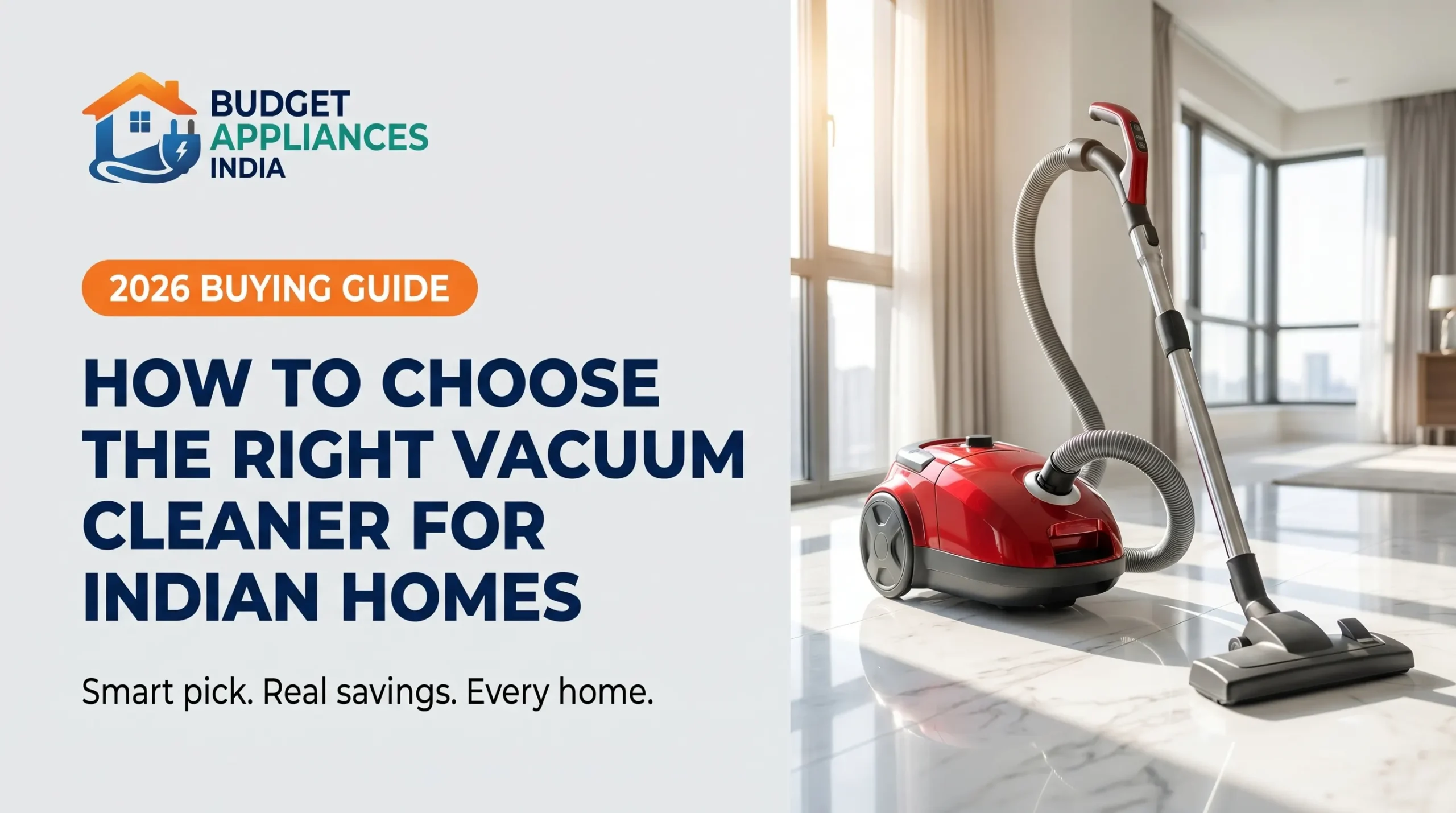
The Ultimate 2026 Buying Guide: How to Choose the Right Vacuum Cleaner for Your Indian Home
If you’ve ever spent a Sunday morning sweeping up that fine, persistent Indian dust only to see it settle back down on your furniture ten minutes later, you know exactly why a vacuum cleaner is no longer a luxury; it’s a necessity. Between the construction dust outside, the pet hair on the rugs, and the occasional spilt dal in the kitchen, a traditional broom just doesn’t cut it anymore.
But walking into an appliance store or scrolling through Amazon can be genuinely overwhelming. Do you need a 1900W powerhouse? Is a wet and dry model overkill? Does “HEPA” actually mean anything for your allergies?
I’ve done the heavy lifting for you. I’ve spent weeks doing a deep dive analysis of the top-selling models in India, poring over technical spec sheets, analysing hundreds of verified customer reviews, and studying real-world performance data to see how these machines handle our specific local conditions. This guide is the result of that research.
📋 What’s Inside This Guide
🔬 The EEAT Factor: Why Trust This Guide?
To give you the most accurate advice, I didn’t just look at marketing fluff. My analysis is built on three core pillars:
My Research Methodology
- Suction vs. Wattage: A 2000W motor is useless if the airflow is poorly designed. I prioritised models with high kPa (suction pressure) ratings over just high wattage numbers on the box.
- Filtration Quality: For Indian homes, a standard sponge filter isn’t enough. I specifically looked for HEPA filters that trap 99% of fine dust particles including allergens.
- Local Serviceability: I analysed the service network of each brand. A vacuum cleaner is a waste of money if you can’t find a service centre in your city when the motor needs attention.
🏠 Understanding the Players: Types of Vacuum Cleaners
Before we get to the specific picks, you need to know which type fits your home’s layout and lifestyle. Through my research of modern Indian homes, I’ve categorised them into four main types:
Canister Vacuum Cleaners
Traditional “tank” style with a long hose. Best performers for deep cleaning due to larger, more powerful motors.
Wet & Dry Vacuums
The “SUV” of vacuums. Stainless steel drum handles liquid spills and dry dust equally, plus a powerful blower function.
Stick & Cordless
Lightweight and perfect for quick spot cleaning in compact 1BHKs. No wires to trip over.
Robot Vacuums
Hands-free daily maintenance on clutter-free hard floors. Won’t replace a deep clean but keeps daily dust at bay.
Which Type Is Right for You?
If you have mostly marble or tile floors, a 20 kPa canister model will clean effectively and run much quieter. If you have a Golden Retriever or thick Persian rugs, you’ll need the strongest suction available. Match your type to your home, not to the spec sheet.
📊 Top Picks: Based on Specs & Real User Feedback
Based on my research into suction power, filtration quality, and long-term durability, here are the best models currently available in India:
| Model | Type | Suction Power | Key Strength | Approx. Price |
|---|---|---|---|---|
| Philips PowerPro FC9352/01 | Canister | 33 kPa | Best Overall Suction & Pets | ₹7,999 |
| Agaro Ace | Wet & Dry | 21.5 kPa | Most Versatile (Wet+Dry) | ₹6,199 |
| Eureka Forbes Supervac | Canister | 21 kPa | Best Build Quality | ₹5,999 |
| INALSA Spruce | Canister | 18 kPa | Compact & Budget Friendly | ₹3,400 |
⚠️ Prices on Amazon fluctuate daily. Always check the links for the most current price before purchasing.
🎯 Key Factors to Consider Before Buying
1. Suction Power: The kPa Rating
Don’t get distracted by Watts (power consumption). Look for the kPa (Kilopascal) rating; this tells you the actual suction pressure the machine generates.
- 15 to 20 kPa: Good for hard floors and light everyday dust
- 20 to 30 kPa: Essential for deep cleaning carpets and stubborn pet hair
- 30+ kPa: Premium performance for heavily dusty homes or thick rugs
2. Filtration System
Indian homes deal with very fine dust that standard sponge filters simply cannot trap. I highly recommend models with a HEPA 13 filter; it ensures the air exhausted back into your room is cleaner than the air sucked in. Absolutely vital for households with asthma or allergy sufferers.
3. Bagged vs. Bagless
- Bagless (Cyclonic): Empty the dust bowl directly into the bin. Saves money on replacement bags, but can release dust when emptying.
- Bagged: More hygienic for allergy sufferers as dust is sealed in the bag. However, you have the ongoing cost of replacement bags.
4. The Blower Function
In the Indian context, a blower is almost as important as suction itself. My research shows users find it indispensable for clearing dust from window tracks, AC vents, sliding door channels, and sofa crevices where the suction head simply can’t reach. Prioritise this feature if your home has lots of tight corners.
🛠️ Maintenance, Electricity Costs & Post-Sale Service
Electricity Running Cost: Less Than You Think
Running a 1600W vacuum for 15 minutes a day consumes about 0.4 units of electricity. At an average rate of ₹8 per unit, that’s roughly ₹3.20 per cleaning session, or about ₹100 per month. A small price for a genuinely dust-free home.
Maintenance by Type
| Task | How Often | Key Watch-Out |
|---|---|---|
| Wash Sponge/HEPA Filter | Once a month | Must dry for 24 hours before reinserting; never use a damp filter or suction drops severely. |
| Check & Clear the Hose | Every 2 to 3 weeks | Stray coins, hair clumps, and small objects are the #1 cause of suction loss complaints. |
| Empty Dust Bowl or Bag | Every 3 to 4 uses | Overfilling significantly degrades suction power over time. |
| Dry Drum After Wet Use | After every wet session | For Agaro Ace and wet/dry models, moisture left inside the steel drum causes rust and mould. |
Post-Sale Service Network
Always Check Service Centre Availability First
Philips & Eureka Forbes have the widest service reach across India, including smaller towns and tier 2 cities. Agaro & Inalsa have excellent coverage in metro cities but may take longer in smaller towns. Always verify a service centre exists in your city before clicking “Buy”.
⚖️ Pros & Cons of Using a Vacuum Cleaner in India
✦ Pros
- Efficiency: Cleans 10x faster than a traditional broom
- Air Quality: HEPA filters trap fine particles, a broom just kicks back into the air
- Versatility: Cleans fans, curtains, sofas, and car interiors with the same machine
- Deep Cleaning: Reaches under furniture and into tight corners brooms miss entirely
✦ Cons
- Noise: Most powerful models are quite loud at 80 to 95 dB
- Storage: Canister and Wet & Dry models need dedicated cupboard space
- Plug Points: You often need to switch sockets as you move room to room
- Maintenance: Filters need regular cleaning to maintain suction performance
✅ Bottom Line: Which One Is Right for You?
One key insight from my research: the “best” vacuum isn’t necessarily the most expensive one; it’s the one that genuinely matches your home’s layout and needs. If you have mostly marble or tile floors, you don’t need 33 kPa suction; a 20 kPa model will be more than sufficient and much quieter. But if you have a pet or thick rugs, skipping high suction is a decision you’ll regret.