
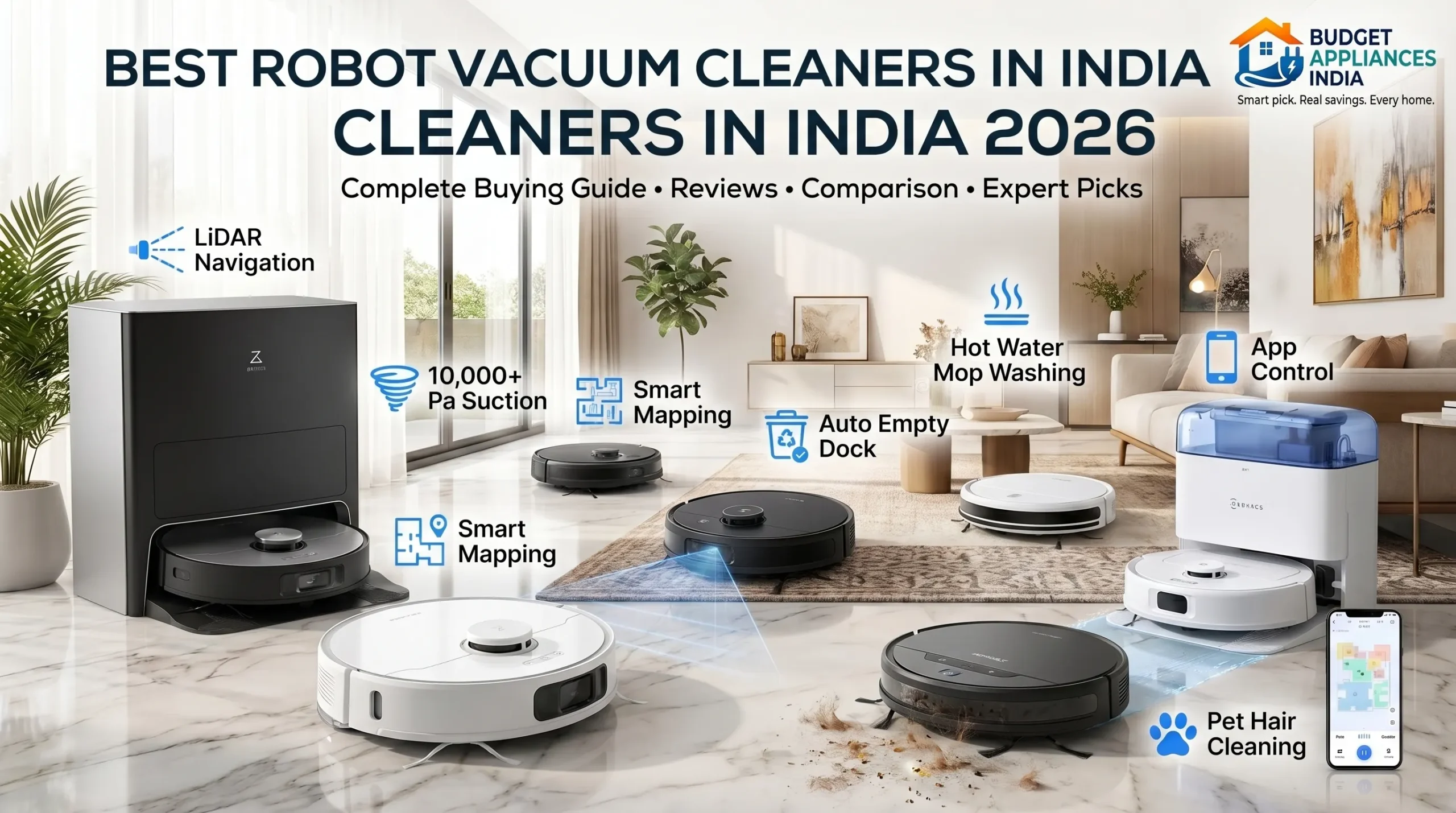
The Ultimate Robot Vacuum Cleaner Buying Guide for Indian Homes (2026): Everything You Need to Know Before Buying
The traditional Indian household ritual of floor cleaning, the daily jhaadoo (sweeping) and poochha (mopping), is undergoing a permanent technological shift. Driven by dual-income households, demanding corporate schedules, and a desire for meticulous, predictable sanitation, robotic vacuum cleaners have transitioned from futuristic novelties into indispensable smart appliances.
However, cleaning an Indian home presents a unique set of challenges: fine tropical dust accumulation from open windows, high-traffic vitrified tile or marble flooring, complex furniture layouts, stubborn kitchen grease (from oil and ghee), and localized spills.
Based on an exhaustive analysis of technical specifications, long-term ownership data, and compiled user feedback across Amazon, YouTube, Reddit, and Quora, this comprehensive consumer guide breaks down everything you need to know before buying a robot vacuum cleaner in India.
📋 What’s Inside This Guide
🧹 Robot Vacuum Cleaner vs Maid: Which One Makes More Sense for Indian Homes?
If you’re thinking about buying a robotic vacuum cleaner, one question probably comes to mind: “Should I invest in a robot vacuum or continue relying on domestic help?”
The answer depends on your budget, lifestyle, and cleaning expectations. While both options have their advantages, the long-term economics and convenience of robotic vacuum cleaners make them an increasingly popular choice among homeowners.
Understanding the Cost Difference
One of the biggest factors influencing this decision is the overall cost. In most urban Indian cities, hiring a maid for sweeping and mopping typically costs between ₹2,000 and ₹4,000 per month. That translates to an annual expense of approximately ₹24,000 to ₹48,000, and the cost continues year after year.
A robotic vacuum cleaner, on the other hand, requires a one-time investment. Most good-quality models are priced between ₹25,000 and ₹55,000, although basic models focused on dry vacuuming can be found for under ₹20,000. Entry-level options are even available below ₹10,000.
Apart from the purchase price, robot vacuums require occasional replacement of filters, brushes, and mop pads. These maintenance costs are usually around ₹2,000 to ₹3,000 per year. Electricity consumption is minimal and typically adds less than ₹50 to ₹100 per month to your power bill.
When Does a Robot Vacuum Pay for Itself?
For many households, a robotic vacuum reaches its breakeven point within one to two years when compared to the ongoing cost of domestic help.
A quality robot vacuum can comfortably last three to five years with proper maintenance. When you spread the total ownership cost across its lifespan, the average monthly expense often comes down to around ₹1,000, making it significantly more economical than hiring a maid for daily floor cleaning.
Convenience and Reliability
This is where robot vacuums often have a clear advantage. A robot vacuum can clean every day without reminders, complaints, or schedule conflicts. You can set it to clean while you’re at work, sleeping, or even in the middle of the night. It follows the same routine consistently and never takes a holiday.
Domestic help certainly provides a human touch, but availability can sometimes become a challenge. Unexpected leaves, varying cleaning standards, and scheduling issues are common concerns for many homeowners.
That said, robot vacuums are not completely maintenance-free. You’ll still need to empty the dustbin, clean brushes, remove tangled hair, and occasionally replace consumable parts. Premium models with self-emptying docks reduce much of this effort, but some maintenance is always required.
Which One Cleans Better?
The answer depends on the type of cleaning you’re looking for. Robot vacuums are excellent at daily maintenance cleaning. They remove fine dust, pet hair, crumbs, and microscopic particles that often accumulate on floors throughout the day. Running a robot regularly helps keep floors consistently clean with minimal effort.
However, domestic help still has an advantage when it comes to deep cleaning tasks. A maid can move furniture, clean behind doors, scrub stubborn stains, handle stairs, and reach areas that most robot vacuums cannot access.
Another important difference is floor preparation. A maid can easily move shoes, toys, cables, or other obstacles while cleaning. A robot vacuum performs best when floors are reasonably clutter-free.
Quick Comparison
| Feature | Robotic Vacuum Cleaner | Domestic Maid |
|---|---|---|
| Annual Cost | Approx. ₹7,000 to ₹14,000 (average over 5 years) | ₹24,000 to ₹48,000 |
| Availability | Available 24/7, including holidays | Fixed timings and occasional leaves |
| Cleaning Strength | Daily dust and maintenance cleaning | Deep cleaning and hard-to-reach areas |
| Management | Requires periodic maintenance | Requires scheduling and coordination |
The Best Solution for Most Homes
For many families, the ideal approach is not choosing one over the other. A hybrid cleaning strategy often delivers the best results: the robot vacuum handles daily cleaning and keeps dust under control, while a maid visits weekly or monthly for deep cleaning, furniture movement, stairs, bathrooms, and other detailed tasks. This combination gives you consistently clean floors, reduces dependence on daily manual labour, and often lowers overall cleaning expenses.
Final Verdict
If your goal is to maintain clean floors every day while saving money in the long run, a robotic vacuum cleaner is a smart investment. It offers convenience, consistency, and lower operating costs over time. However, if your home requires frequent deep cleaning, furniture movement, or extensive manual work, domestic help still plays an important role.
For most modern Indian households, the winning formula is simple: let the robot handle daily cleaning and reserve human help for tasks that truly need a human touch.
⚙️ What Features Matter Most for Indian Floors in a Robot Vacuum Cleaner?
Not all robotic vacuum cleaners are designed with Indian homes in mind. Most Indian households have hard flooring such as polished marble, vitrified tiles, granite, or ceramic tiles. These surfaces present unique cleaning challenges, including fine dust, hair, kitchen grease, and elevated door thresholds. As a result, the features that truly matter may be very different from the specifications highlighted in marketing advertisements.
If you’re shopping for a robot vacuum cleaner for an Indian home, here are the key technologies worth prioritizing.
1. Suction Power: More Isn’t Always Better
One of the first specifications buyers notice is suction power. Many brands advertise extremely high numbers, but bigger figures do not automatically translate into better cleaning performance on hard floors. For most Indian homes with marble, granite, or tile flooring, a suction range of 3,000 Pa to 5,000 Pa is generally sufficient for everyday dust, fine particles, pet hair, and small debris.
Higher suction levels become useful when your home includes thick carpets, large rugs, or floor transitions where dirt can become deeply embedded. In such cases, models offering 8,000 Pa or more can provide a noticeable advantage. For hard-floor homes, it is often better to focus on navigation and mopping quality rather than chasing the highest suction number.
2. LiDAR Navigation: The Brain of the Robot
Navigation technology plays a major role in determining how efficiently a robot cleans your home. For Indian households, LiDAR navigation should be considered an essential feature rather than a luxury.
LiDAR uses laser sensors to scan and map your home with impressive accuracy. Within a few cleaning cycles, the robot creates a detailed floor plan and learns the most efficient cleaning routes. One of its biggest advantages is the ability to work effectively in low-light conditions or complete darkness, unlike camera-based systems that may struggle in dim rooms. If your home has multiple rooms or a complex layout, LiDAR navigation can significantly improve cleaning efficiency and coverage.
3. Active Mopping Delivers Better Results
Mopping performance is particularly important in Indian homes where kitchen floors often deal with oil splashes, ghee residue, and sticky spills. Basic robot vacuums typically use passive mopping systems that simply drag a damp cloth across the floor, which is often ineffective against tougher stains.
A better solution is a robot equipped with rotating mop pads or roller-based mopping systems that actively scrub the floor. Many premium models now include automatic mop washing stations using hot water ranging from 60°C to 100°C, which helps dissolve oily residues and keeps mop pads cleaner between uses, especially valuable in India’s humid climate where damp mop pads can develop odors.
4. Edge Cleaning Matters More Than You Think
Dust tends to accumulate along walls, skirting boards, and room corners. To address this, many advanced robot vacuums now feature technologies that allow the mop pad to extend outward while cleaning edges, helping the robot reach areas that traditional round designs often miss. For homeowners who want cleaner corners and better wall-edge coverage, this can make a noticeable difference in everyday cleaning results.
5. Threshold Climbing for Indian Homes
Many Indian homes have raised marble or stone thresholds between rooms. While most robot vacuums can cross obstacles up to about 2 cm, some homes have higher transitions that can create difficulties for standard models. If your home has elevated door thresholds, check the robot’s climbing capability before purchasing; models with enhanced wheel systems or advanced obstacle-climbing technology are better suited for these environments.
6. Anti-Tangle Brushes Reduce Maintenance
Hair entanglement is one of the most common complaints among robot vacuum owners. Long human hair, pet fur, and threads can wrap around traditional brushes, reducing cleaning performance and requiring frequent manual cleaning. Many modern robot vacuums now feature anti-tangle brush designs, floating brush systems, or specialized cutting mechanisms that help prevent hair from wrapping around the brush roll, significantly reducing maintenance.
7. Auto-Empty Docks Add Convenience
While not essential, auto-empty stations can greatly improve the ownership experience. These docking stations automatically transfer dust from the robot’s dustbin into a larger disposable or reusable bag, meaning you may only need to empty the system every few weeks instead of after every cleaning session. For larger homes or busy families, this added convenience can make a robot vacuum feel far more hands-free.
Quick Feature Checklist for Indian Homes
Before buying a robotic vacuum cleaner, make sure it offers the following:
| Feature | Recommended for Indian Homes |
|---|---|
| Navigation | LiDAR-based mapping and navigation |
| Suction Power | 3,000 to 5,000 Pa for hard floors; 8,000+ Pa for carpets |
| Mopping System | Rotating or roller mops with active scrubbing |
| Hot Water Cleaning | 60°C or higher for better grease removal and hygiene |
| Threshold Climbing | At least 2 cm obstacle crossing capability |
| Maintenance | Anti-tangle brushes and self-cleaning features |
| Convenience | Auto-empty dock for reduced manual effort |
When choosing a robot vacuum cleaner for Indian flooring, navigation and mopping performance often matter more than headline suction numbers. A robot equipped with LiDAR navigation, active mopping, anti-tangle brushes, and reliable threshold climbing will generally deliver a much better experience than a model that focuses only on high suction power. By prioritizing the features that address the realities of Indian homes, you can invest in a robot vacuum that keeps your floors consistently clean while requiring minimal effort from you.
🔋 The Automation Tier: Hands-Free Docks vs. Manual Maintenance
When shopping for a robotic vacuum cleaner, most buyers focus on suction power, navigation technology, or mopping performance. However, one feature that has an even bigger impact on day-to-day ownership is the automation level of the docking station.
The dock determines how much maintenance you’ll need to perform and how hands-free the overall experience will be. Some robots still require daily attention, while others can operate for weeks with minimal user involvement. Robot vacuums can generally be divided into three automation tiers.
1. Manual Maintenance Tier
Commonly found in robot vacuums priced below ₹20,000. These models focus on delivering reliable cleaning performance at an affordable price, but they require regular user involvement. After cleaning, you’ll typically need to:
- Empty the dustbin manually
- Refill the water tank before mopping
- Attach and remove the mop cloth
- Wash and air-dry the mop pad after every use
Most of these robots use basic drag-style mopping systems. If the mop cloth is not cleaned and dried properly, it can develop unpleasant odors and bacterial buildup over time. While the maintenance routine is not difficult, it does require consistent attention.
Best for: Small apartments, budget-conscious buyers, and first-time robot vacuum owners who don’t mind spending a few minutes on daily maintenance.
2. Semi-Automatic Tier
Typically available in the ₹20,000 to ₹30,000 price range, these models introduce auto-empty docking stations that automatically transfer dust and debris from the robot’s onboard dustbin into a larger collection bag or container inside the dock. This means you can often enjoy up to 60 days of hands-free vacuuming before needing to empty the dock, which is especially helpful in homes with pets, children, or heavy dust accumulation.
However, mopping remains largely manual. You’ll still need to:
- Remove the mop pads
- Wash them after each cleaning session
- Allow them to dry properly
- Refill water tanks when required
As a result, vacuuming becomes largely automated, but mopping still requires user involvement.
Best for: Busy households that primarily want automated vacuuming while keeping costs under control.
3. Fully Automatic Tier
At the premium end of the market, you’ll find robot vacuums equipped with advanced all-in-one docking stations, often marketed as Omni, Ultra, Pro, or Complete Cleaning systems. Depending on the model, the docking station can:
- Empty the robot’s dustbin automatically
- Refill the robot’s clean water tank
- Collect dirty water in a separate reservoir
- Wash and dry mop pads using heated air
- Perform self-cleaning cycles
One of the most valuable features is automatic mop washing and drying using hot water, which helps remove grease, oil residue, and stubborn dirt, then keeps pads fresh via heated air drying, particularly useful in humid climates. Although these systems dramatically reduce maintenance, users still need to refill the clean water tank and empty the dirty water container periodically, usually once or twice a week depending on cleaning frequency.
Best for: Large homes, pet owners, busy families, and anyone seeking the most hands-free cleaning experience possible.
Automation Tier Comparison
| Feature | Manual Tier | Semi-Automatic Tier | Fully Automatic Tier |
|---|---|---|---|
| Dust Emptying | After every cleaning run | Every 30 to 60 days | Every 60 to 100 days |
| Mop Pad Care | Manual washing and drying after each use | Manual washing and drying after each use | Automatic washing and drying |
| Water Refilling | Manual daily filling | Manual daily filling | Automatic refill from dock |
| User Involvement | Daily maintenance | Combination of daily and weekly maintenance | Weekly or bi-weekly checks |
Maintenance Tasks Every Robot Owner Should Expect
Regardless of whether you buy a budget model or a premium flagship, some maintenance responsibilities remain the same.
| Task | How Often | Key Watch-Out |
|---|---|---|
| Brush & Wheel Cleaning | Weekly | Remove hair tangled around the main brush, clean side brushes, and check wheels for dust buildup. Homes with pets or long hair may require more frequent cleaning. |
| Sensor Cleaning | Monthly | Wipe the LiDAR sensor tower, clean cliff sensors, and remove dust from obstacle-detection sensors to maintain accurate navigation. |
| Consumable Replacement | Every 3 to 6 months | HEPA filters, side brushes, main brushes, and microfiber mop pads eventually wear out; replacing them on schedule extends the robot’s lifespan. |
The right automation tier depends on how much maintenance you’re willing to handle. If you’re comfortable spending a few minutes each day, a manual maintenance model can provide excellent value. If your main goal is eliminating the hassle of dustbin emptying, a semi-automatic model with an auto-empty dock is a great middle ground. For homeowners who want the closest thing to a truly hands-free cleaning system, a fully automatic dock offers the most convenience and the least daily effort.
Final Thoughts on Automation
The real difference between robot vacuums is not just how they clean but how much work they save you afterward. A budget model can automate floor cleaning, but a premium fully automatic system can automate much of the maintenance as well. Understanding these automation tiers before you buy will help you choose a robot vacuum that fits both your budget and your expectations.
⚠️ Real-World Ownership Challenges & Pain Points
Robot vacuum cleaners can save a significant amount of time and effort, but it’s important to have realistic expectations before investing in one. While modern robot vacuums are incredibly convenient, they are not completely maintenance-free. Like any household appliance, they require occasional upkeep and can face certain limitations, especially in Indian homes. Understanding these challenges before you buy can help you choose the right model and avoid disappointment later.
1. Regular Maintenance Is Still Required
One of the biggest misconceptions about robot vacuums is that they can be left alone indefinitely. In reality, even premium models require periodic maintenance to keep them performing at their best.
Hair and Fur Can Get Tangled: Households with long hair or shedding pets will likely encounter brush tangles every one to two weeks. Many newer models include anti-tangle brush designs, but no system is completely immune.
Consumable Parts Need Replacement: HEPA filters, side brushes, main brushes, and mop pads generally need replacement every three to six months to maintain optimal performance and hygiene.
Budget Models Need More Attention: Basic robot vacuums without an advanced dock require manual dustbin emptying, water refilling, and mop washing and drying after every cleaning cycle. Skipping these steps can lead to unpleasant odors and reduced cleaning effectiveness.
Even Premium Docks Need Care: Fully automatic docking stations dramatically reduce maintenance but still require refilling clean water tanks, emptying dirty water containers, and periodically cleaning the dock tray.
2. Software and Navigation Are Not Perfect
Modern robot vacuums rely heavily on software, sensors, and mapping technology. While these systems have improved significantly, occasional frustrations can still occur.
Mirrors and Glass Can Confuse Mapping: Large floor-to-ceiling mirrors and glass partitions can interfere with LiDAR navigation, as laser sensors may interpret reflections as additional rooms or open spaces.
Wi-Fi and App Issues Can Happen: Users occasionally report Wi-Fi connectivity problems, app synchronization issues, difficulty saving custom no-go zones, and delayed map updates. These are usually software-related and often improve through firmware updates.
Robots Sometimes Make Mistakes: Even advanced navigation systems can occasionally fail to locate the charging dock, take inefficient cleaning routes, misidentify dark carpets as drop-offs, or get stuck in unexpected locations. Most of these issues are rare but worth keeping in mind.
3. Indian Homes Present Unique Physical Challenges
Many Indian homes have architectural features that can create obstacles for robot vacuums.
Door Thresholds Can Be Problematic: Raised marble and stone thresholds are common in Indian construction. While many robot vacuums can climb obstacles up to 2 cm, taller thresholds may cause the robot to get stuck or lose traction, requiring manual intervention.
Cluttered Floors Reduce Efficiency: Charging cables, shoelaces, toys, clothing, and small household objects can become trapped in brushes or wheels, causing the robot to stop and request assistance. A quick floor check before cleaning can prevent most of these issues.
Limited Reach Remains a Reality: Most models cannot clean stairs, dust furniture, reach high shelves, access tight corners perfectly, or clean narrow gaps behind doors. They are excellent for floor maintenance but are not a complete substitute for deep cleaning.
4. Cleaning Performance Has Some Limitations
Robot vacuums excel at daily cleaning, but they do have certain performance gaps.
Basic Mopping Is Often Limited: Entry-level models use passive mopping systems that simply drag a damp cloth across the floor. While this removes light dust and footprints, it often struggles with oily kitchen residue, dried food spills, grease stains, and sticky patches. Households that prioritize mopping should consider models with rotating or roller mop systems.
Pet Owners Need to Be Careful: Standard robot vacuums cannot reliably detect wet pet waste. If the robot encounters it during a cleaning cycle, it may spread the mess across multiple rooms before stopping. Homes with pets should look for advanced obstacle-recognition systems designed to identify and avoid such hazards.
Auto-Emptying Can Be Surprisingly Loud: Most robot vacuums operate at a comfortable noise level during cleaning. However, the auto-emptying process at the docking station is often significantly louder, creating a short burst of noise lasting around 15 to 30 seconds.
5. After-Sales Service Can Be a Deciding Factor
For many buyers in India, after-sales support is just as important as cleaning performance.
Service Quality Varies by Brand: Some manufacturers offer dedicated service networks, while others rely on third-party service partners, so support experiences can vary significantly between brands and locations.
Repair Turnaround Times May Be Longer Than Expected: Users have reported extended repair wait times, multiple follow-ups for service requests, and limited availability of nearby service centers, which is why researching a brand’s service reputation before purchasing is highly recommended.
Spare Parts Availability Matters: For older models, sourcing genuine spare parts can sometimes become difficult, particularly if the brand has a limited presence in India. Choosing a manufacturer with strong local support can help avoid future headaches.
Set Realistic Expectations
Robot vacuum cleaners are among the most useful smart home appliances available today, but they are not magic devices that eliminate every cleaning responsibility. They still require maintenance, occasional troubleshooting, and realistic expectations about what they can and cannot do. The good news is that most of these limitations are manageable, and for many homeowners, the convenience of automated daily cleaning far outweighs the occasional maintenance task. Understanding these challenges before buying will help you choose a robot vacuum that fits your home, lifestyle, and expectations, leading to a much more satisfying ownership experience.
🏆 Best Robot Vacuum Cleaners of 2026: Quick Picks
Looking for the best robot vacuum cleaner in India? Here are our top recommendations for 2026 across different budgets and use cases.
Best Overall
Best Premium All-Rounder
Best Luxury Flagship
Best Value for Money
Best for Apartments
Best Budget Choice
Best Budget Option for Large Homes
Best for Pet Owners
✅ The Definitive Pre-Purchase Checklist
Buying a robot vacuum cleaner is a significant investment, and choosing the right model can make the difference between a genuinely helpful smart appliance and a frustrating purchase.
With so many options available, it is easy to get distracted by marketing claims and impressive specifications. Before making your final decision, take a few minutes to go through this practical checklist to ensure the robot vacuum is a good fit for your home and lifestyle.
1. Check the Navigation System
The navigation system is the brain of a robot vacuum and has a huge impact on cleaning efficiency.
Look for LiDAR Navigation: For most Indian homes, LiDAR navigation should be at the top of your checklist. LiDAR-equipped robots create highly accurate maps, clean in organized patterns, and can operate effectively even in complete darkness; they are generally far more reliable than camera-only or random-navigation models. If you plan to schedule cleaning sessions at night or have a home with multiple rooms and furniture, LiDAR is strongly recommended.
Multi-Floor Mapping Matters: If your home has multiple floors, check whether the robot can store multiple maps. This feature allows the robot to recognize different levels of your home without needing to create a new map every time it changes floors.
2. Evaluate Cleaning and Mopping Performance
Not all robot vacuums clean the same way, especially when it comes to mopping.
Choose the Right Suction Power: For homes with marble, granite, ceramic tiles, or vitrified flooring, a suction range of 3,000 to 5,000 Pa is usually more than sufficient. Higher suction levels become important if you have thick carpets, large rugs, pets that shed heavily, or heavy dirt accumulation; in these situations, a model with 8,000 Pa or higher may be worth considering.
Active Mopping Is Worth It: Rotating mop pads and roller mops provide active scrubbing action and generally perform much better on dried stains and kitchen residue. Basic drag-style mops are suitable for light dust removal but may struggle with tougher messes.
Hot Water Mop Washing Is a Bonus: Premium docking stations often include hot-water mop cleaning, which helps remove grease, oil residue, and stubborn dirt while keeping mop pads cleaner and more hygienic between cleaning sessions.
3. Decide How Much Automation You Want
One of the biggest differences between robot vacuums is the level of maintenance they automate.
- Manual Models require dustbin emptying, manual water refilling, and mop washing and drying after cleaning. They are usually the most affordable option.
- Semi-Automatic Models include auto-empty docks that handle dust collection for several weeks, though mop maintenance still requires manual effort.
- Fully Automatic Models can empty dustbins, wash and dry mop pads, and refill water tanks automatically, requiring the least day-to-day involvement.
Check Available Space for the Dock: Fully automated docks are significantly larger than standard charging bases and require access to a nearby power outlet.
Bagged or Bagless? Some docks use disposable dust bags, while others use reusable bagless containers. Bagless systems can help reduce long-term maintenance costs.
4. Make Sure It Fits Your Home
A robot vacuum may have excellent specifications, but it still needs to navigate your home’s physical layout.
Check the Robot’s Height: If you want the robot to clean beneath beds, sofas, or low furniture, check its overall height. Models under 9.5 cm are generally better at reaching tight spaces.
Measure Door Thresholds: Many Indian homes have raised marble or stone thresholds between rooms. If these transitions are higher than 1.5 to 2 cm, some robots may struggle to cross them. In such cases, look for models with enhanced climbing capabilities.
Consider Pet-Friendly Features: Pet owners should prioritize anti-tangle brush systems, strong suction, advanced obstacle avoidance, and pet waste detection technology.
5. Research Service and Support
A robot vacuum is a long-term appliance, so after-sales support should never be overlooked.
Verify Local Service Availability: Before purchasing, confirm whether the brand provides service support in your city. A nearby service network can save considerable time and inconvenience if repairs are needed.
Check Spare Parts Availability: Common replacement items include HEPA filters, side brushes, main brushes, and mop pads. Ensure these parts are readily available through major online marketplaces and authorized retailers.
Review the Warranty: Pay attention to coverage for critical components such as LiDAR sensors, water pumps, batteries, and docking stations. A strong warranty can provide added peace of mind.
6. Confirm Connectivity Features
Modern robot vacuums rely heavily on smartphone apps and wireless connectivity.
Ensure Reliable Wi-Fi Coverage: Most robot vacuums operate on a 2.4 GHz Wi-Fi network. Make sure your router provides stable coverage throughout the areas where the robot will clean.
Check the App Features: A good companion app should include virtual no-go zones, room-specific cleaning, custom cleaning schedules, adjustable water flow settings, and cleaning history and reports.
Final Checklist Before You Buy
Before placing your order, ask yourself these questions:
- Does it use LiDAR navigation?
- Is the suction power suitable for my flooring type?
- Does it offer the mopping performance I need?
- Am I comfortable with the maintenance level?
- Can it cross my home’s thresholds?
- Will it fit under my furniture?
- Are spare parts and service available locally?
- Does the app provide the features I want?
If you can confidently answer “yes” to most of these questions, you’re far more likely to choose a robot vacuum that delivers excellent performance and long-term satisfaction.
The best robot vacuum cleaner is not necessarily the most expensive one. It is the model that best matches your home’s layout, cleaning needs, maintenance preferences, and budget. Using this checklist before purchasing can help you avoid costly mistakes and ensure you invest in a robot vacuum that genuinely makes everyday life easier.
Great content! Keep up the good work!
Thank You!!!